


High-Speed Link Switches for the Automotive Industry
With TZ switches, you can route automotive high-speed links flexibly, with low loss, and in a reproducible manner—enabling faster development, more reliable validation, and more efficient testing of cameras, displays, ECUs, and other ADAS components.
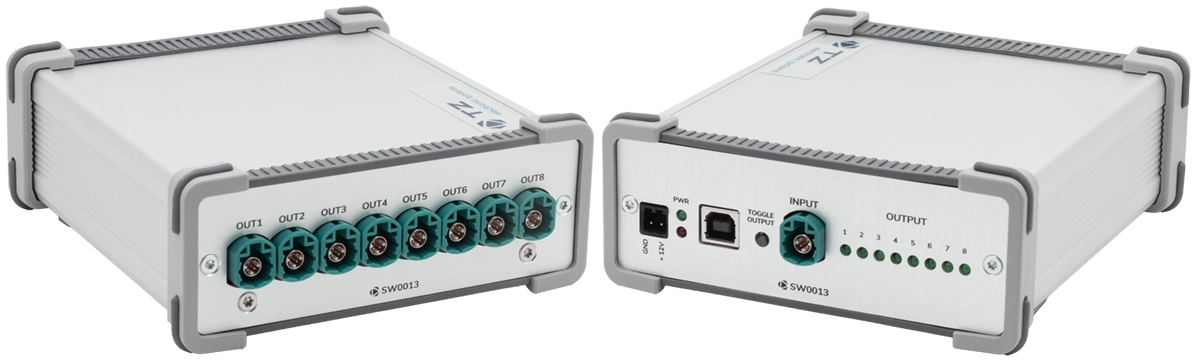
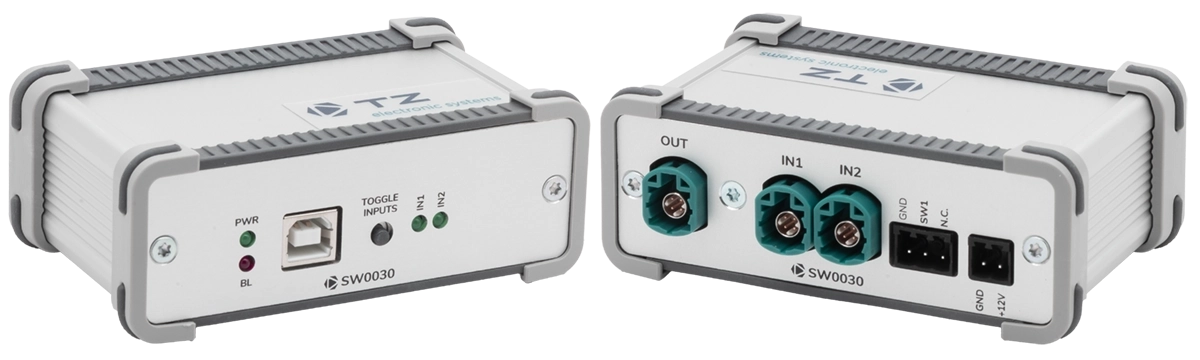
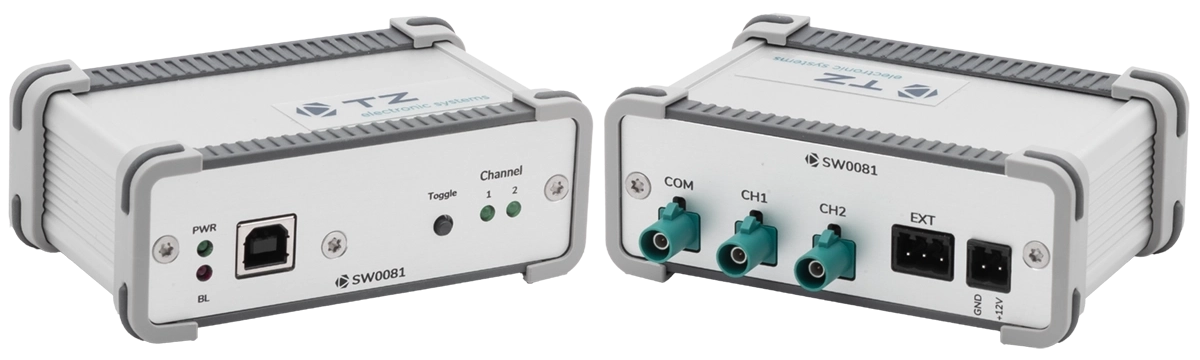
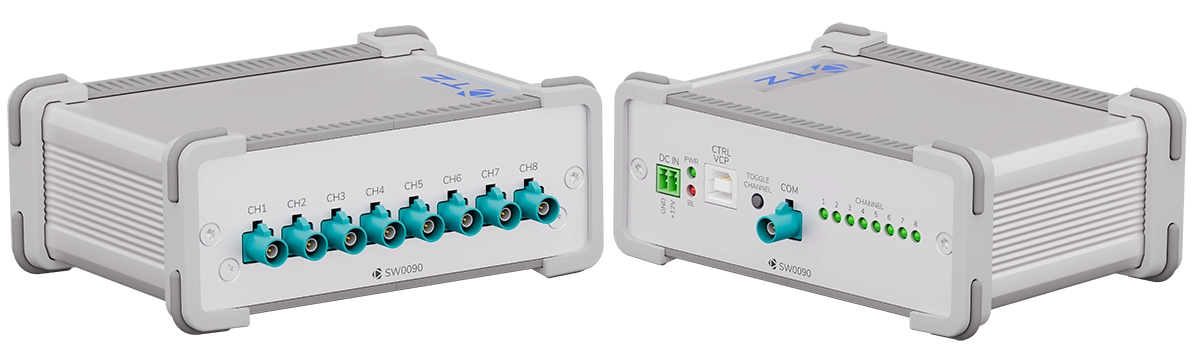
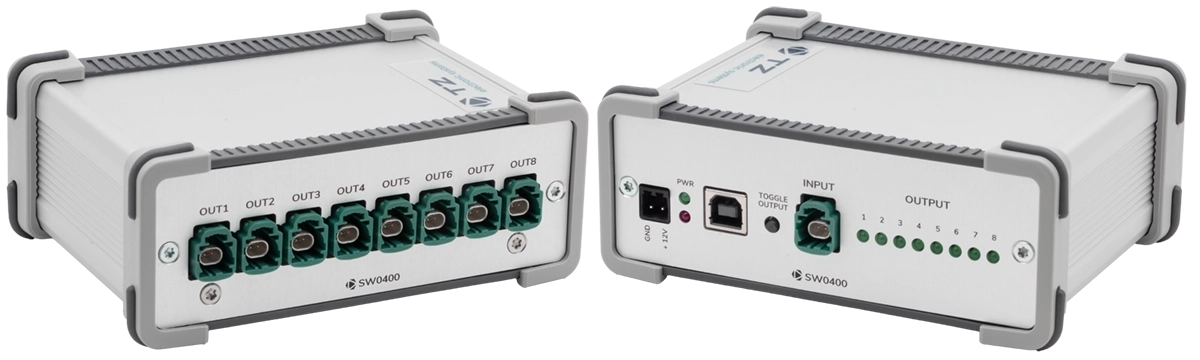
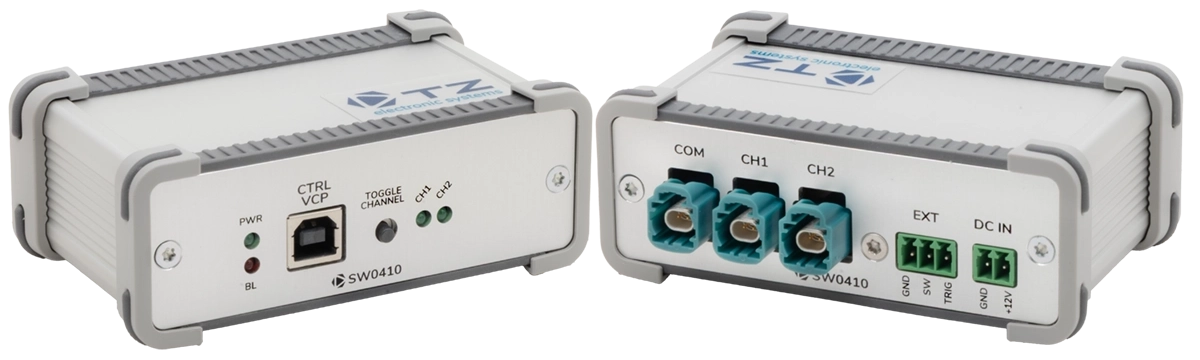
Precise Signal Management for Development and Testing
TZ switches enable precise, low-loss switching between multiple sources and sinks and were developed for professional test and development environments in the automotive sector. Depending on the model, TZ switches are available with Rosenberger HSD, FAKRA, or H-MTD connectors. The switches support bidirectional signal routing, USB control, and—depending on the variant—external switching or trigger inputs.
TZ solutions for switching and routing automotive video links are used in development, validation, and production-ready test environments for cameras, displays, ECUs, and other automotive video and ADAS components.
Why TZ Switches
TZ Switches are not positioned as generic communication or network switches, but rather as standalone test and switching solutions for automotive video links. The devices were designed for structured integration into development, validation, and pre-production testing workflows.
These products enable bidirectional data transmission; they feature low signal loss, are compact and robust, and are ideally suited for automated and reproducible test sequences. This makes them suitable for both traditional automotive video link tests and—depending on the model—for RF/HF-related applications and modern H-MTD/Automotive Ethernet-related test environments.
Today, TZ switches are used by vehicle manufacturers, Tier 1 suppliers, and development service providers worldwide to efficiently develop, validate, and test modern camera, display, ECU, ADAS, and communication systems.
Technology and Connector Compatibility
Standards and
Technologies
GMSL2
FPDLink III
GMSL2
FPDLink III
GMSL2
GMSL3
FPDLink III
FPDLink IV
GVIF
GMSL2
GMSL3
FPDLink III
FPDLink IV
GVIF
GMSL2
FPDLink III
100BASE-T1
1000BASE-T1
GMSL2
GMSL3
FPDLink III
FPDLink IV
100BASE-T1
1000BASE-T1
2.5GBASE-T1
5GBASE-T1
Channels
Interface
Switching
Button
Switch /
Trigger Input
capable
Applications for TZ Switches

For Development and Validation
TZ Switches help development and validation teams efficiently validate modern vehicle architectures. Typical applications include hardware-in-the-loop (HiL) test benches, component testing during development, integration and system testing, and the validation of video, data, and communication connections. By flexibly switching between different signal paths, test setups can be simplified, automated, and made reproducible.

For Production and End-of-Line
In production and end-of-line environments, TZ switches enable the efficient execution of automated test sequences and repeatable functional tests. Multiple components and test objects can be flexibly integrated into existing test systems, reducing changeover times and allowing for optimal utilization of test resources. The result is greater efficiency, better scalability, and reproducible test results.

For camera, video, and ADAS-related test environments
Automotive manufacturers and Tier 1 suppliers use TZ Switches to develop, integrate, and validate modern camera, display, and ADAS systems. Typical applications range from evaluating individual cameras to multi-camera systems and validating complex video and sensor networks. Flexible signal switching allows for the efficient testing and comparison of different operating states, signal sources, and system configurations.

For modern H-MTD and Automotive Ethernet test environments
As vehicles become increasingly connected, the demands on test environments for automotive Ethernet and modern high-speed communication systems are growing. TZ switches support flexible switching and validation of H-MTD-based connections and are suitable for testing 100BASE-T1, 1000BASE-T1, 2.5GBASE-T1, and 5GBASE-T1 networks. This enables the efficient development, integration, and validation of both individual communication links and complex system architectures.
PoC Support for Camera-Based COAX Architectures
- The TZ switches with FAKRA or HFM connectors support Power over Coax (PoC). In this configuration, both the high-speed data signal and the DC power supply are routed through the selected signal path. The switches are therefore particularly well-suited for automotive camera test systems in which data and power are transmitted together over a coaxial cable.
- The switches do not generate or regulate the camera’s supply voltage. The required voltage must be provided by the connected ECU, the test system, or an external PoC injector. If an external, flexibly adjustable camera power supply is required, the TZ switches can be used with a TZ Power Injector .
Custom Variants


Customization Options
- Connector Type and Variant Coding
- Number of Inputs and Outputs
- Various housing options (desktop units, for in-vehicle use, 19-inch models)
- Interface for external control: USB, Ethernet, digital I/O
Product Overview
FAQ
Who uses TZ Switches?
What are TZ switches designed for?
What types of connectors are available?
Which models are particularly suitable for RF/HF-related applications?
Which models are suitable for test environments closely related to automotive Ethernet?
Do the COAX switches support Power over Coax (PoC)?
Yes. The TZ COAX switches support Power over Coax (PoC). In this process, the high-speed data signal and the DC power supply are transmitted together over the selected signal path.
However, the switches do not generate or regulate the camera’s supply voltage. The voltage must be provided by the connected ECU, the test system, or an external PoC injector.
If an external, flexibly adjustable power supply for the camera is required, the TZ Switch can be combined with a TZ Power Injector. The voltage and current limits specified for the respective model must be observed.
Are custom switch variants available?
Yes. If the standard products do not fully cover the desired test architecture, TZ also develops custom switch solutions.
Possible adjustments include, for example:
- Alternative connectors and coding systems,
- Project-specific number of inputs and outputs,
- Custom switch topologies,
- Desktop, automotive, or 19-inch enclosures,
- USB, Ethernet, or digital control,
- Additional trigger and control inputs,
- Integration of a power of coax feed-in,
- Voltage or current measurement,
- Custom user interfaces.
The implementation is tailored to the specific link architecture and the planned test procedure.
What test scenarios can be implemented using TZ switches?
TZ switches are designed for the flexible and repeatable interconnection of high-speed links in the automotive industry within development, validation, HiL, production, and end-of-line test environments. Typical application scenarios include:
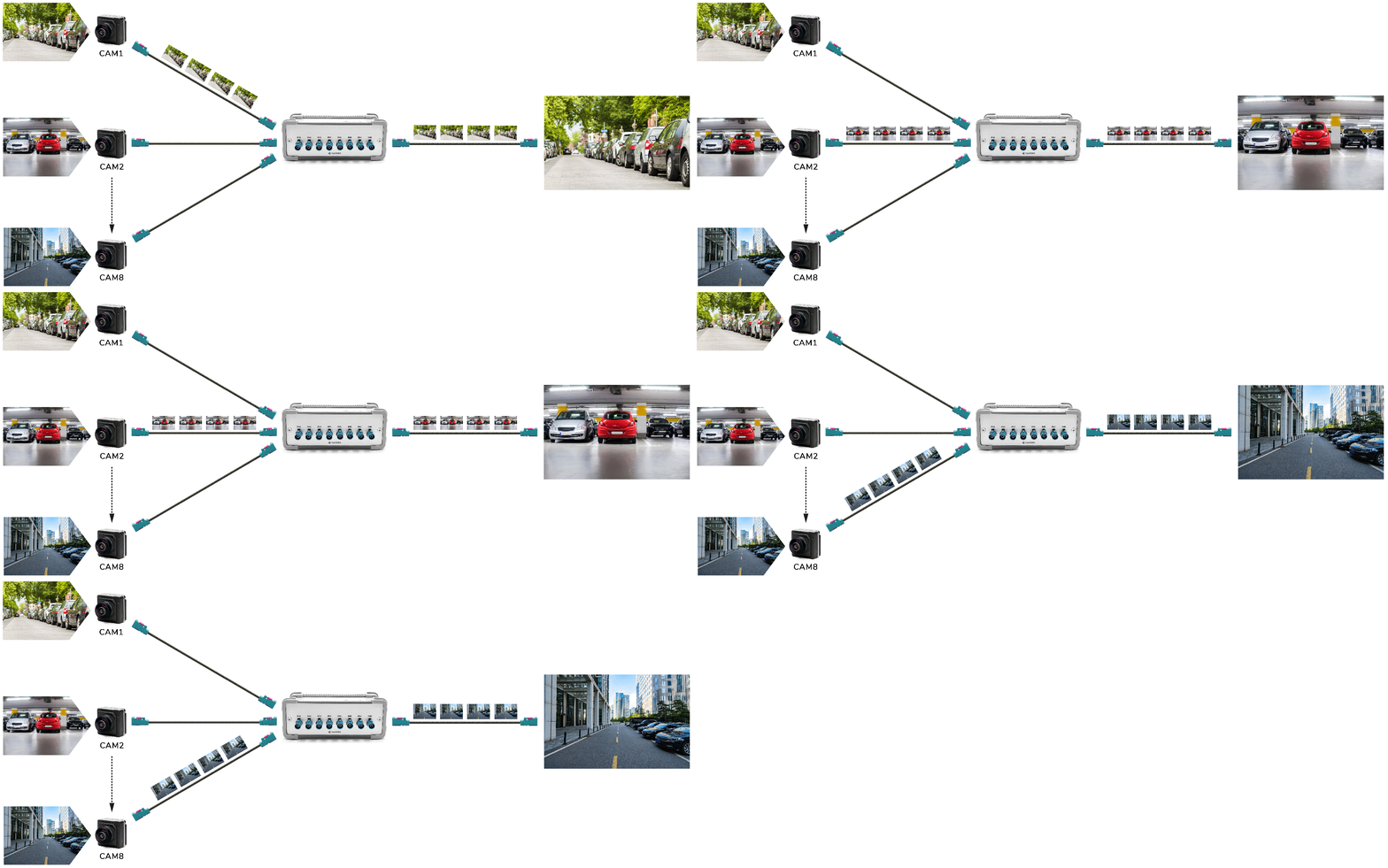
- Switching multiple cameras to a control unit, a frame grabber, or a measuring device
- Switching a camera between multiple control units, displays, or frame grabbers
- Automated Camera Selection in HiL Test Benches
- A/B comparison of cameras, cables, control units, or other components
- Automated Validation of GMSL, FPD-Link, GVIF, and Automotive Ethernet Connections
- Reproducible Connection and Endurance Tests
- End-of-line testing of cameras, control units, displays, and ADAS components
- Flexible routing between test objects and measuring instruments
- Physical Switching of Automotive Ethernet Connections Without Protocol Conversion
- Remote Switching in Laboratory, Validation, and Production Systems
The use of TZ switches, which eliminate the need to manually reconnect cables, simplifies test setups and enables automated, repeatable test procedures.
Are TZ switches bidirectional?
Yes. TZ switches enable bidirectional signal transmission. This allows multiple signal sources to be routed to a single receiver, or a single signal source to be routed to multiple receivers. Typical configurations include, for example:
- Connect multiple cameras to a single ECU or frame grabber,
- Switch a camera between multiple ECUs or test systems,
- Flexibly connect different components within a test setup.
Does a TZ Switch process or modify the transmitted signal?
No. TZ switches route the physical signal path and do not perform any protocol conversion or content processing of the transmitted data.
The device operates transparently with respect to the transmitted protocol. It does not decode, process, or convert either video or Ethernet data. This allows the switches to be integrated into test systems for various high-speed automotive technologies, provided that the respective model is designed for the interface and data rate being used.
Can TZ switches be controlled automatically from a PC?
Yes. The standard models feature a USB interface and can therefore be integrated into automated test environments.
Depending on the model, the following additional operating and control options are available:
- Shift key located directly on the device,
- Connection for an external switch,
- External digital control or trigger inputs,
- Customized control via Ethernet or digital I/Os.
This makes TZ switches suitable for applications such as automated validation systems, HiL test benches, and end-of-line test systems.
What is the difference between a TZ switch and an Ethernet network switch?
A TZ Switch is a physical signal switch, not a managed Ethernet network switch.
The TZ Switch connects selected ports to one another at the physical layer. It does not analyze data packets, assign network addresses, or perform any Ethernet routing or management functions.
Depending on their technical design, the H-MTD models can be used in test environments for Automotive Ethernet connections. In this process, the physical signal path is switched without converting or processing the transmitted Ethernet protocol.