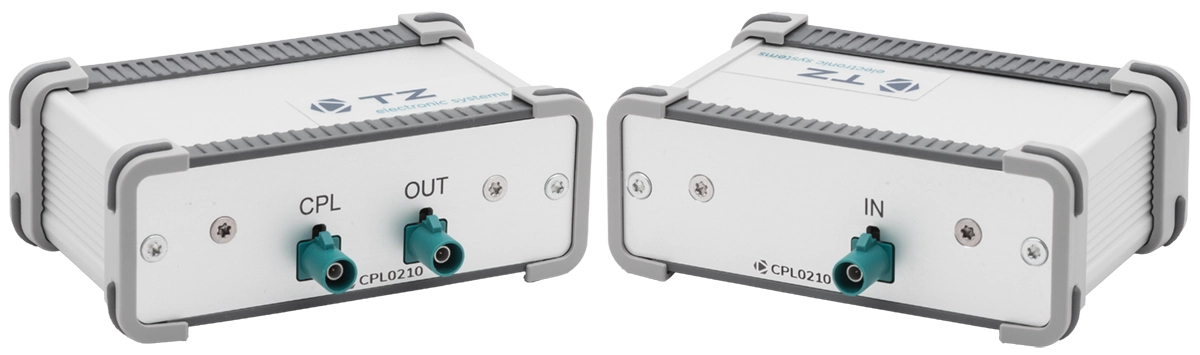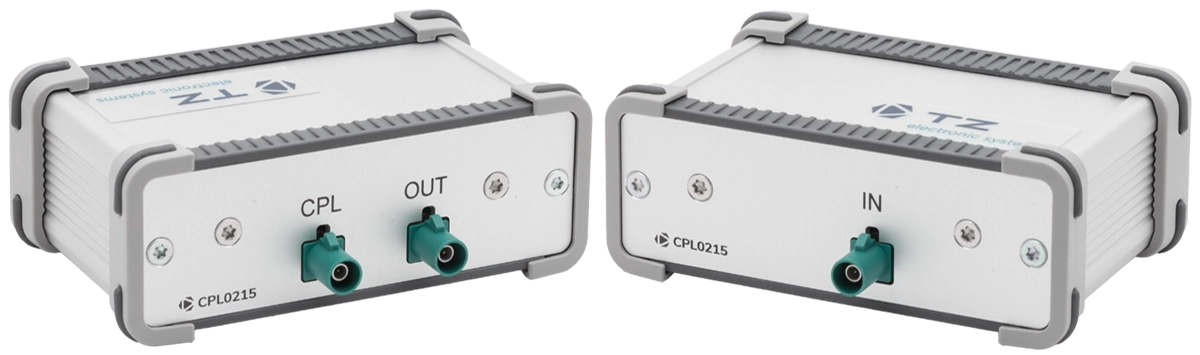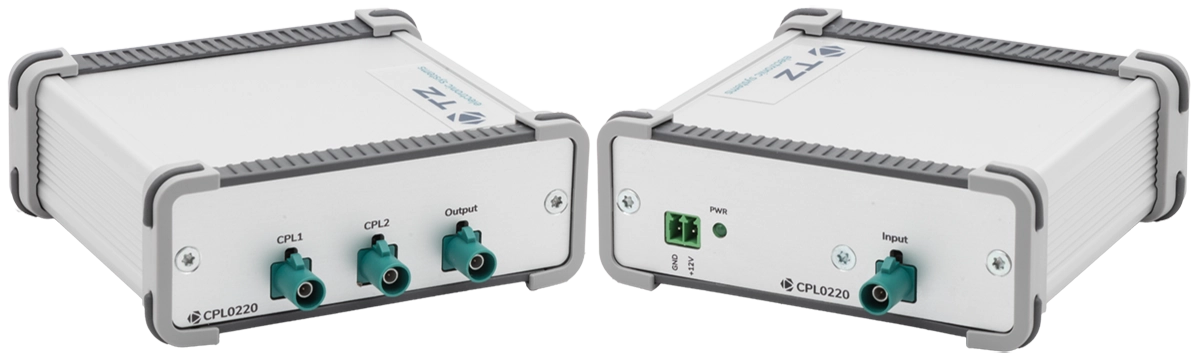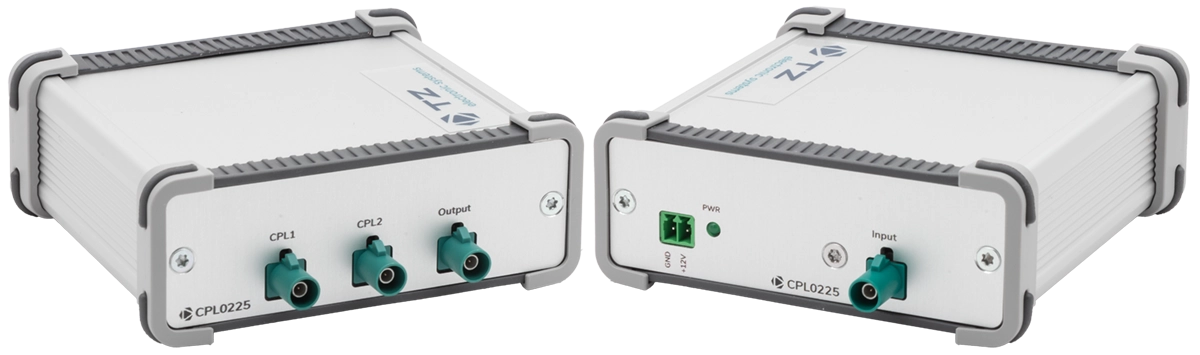

COUPLER
Lossless tapping of automotive video data
Our couplers are designed to extract video signals from automotive video links such as GMSL and FPD-Link in real operation for analysis and recording. Their particular advantage lies in their passive operation: this makes them independent of the link technology and reduces the impact on connected components such as cameras, head units or displays to an absolute minimum, thereby guaranteeing signal integrity.
Features
- Loss-free extraction of video signals: The couplers enable video signals to be extracted from running video systems without affecting the signal.
- Analysis and recording in real operation: Ideal for test drives, test series and hardware-in-the-loop endurance tests.
TZ couplers are manufactured for the common technology standards GMSL and FPD-LINK. We are also happy to implement other technologies and connectors individually for you on request.
Use case 1
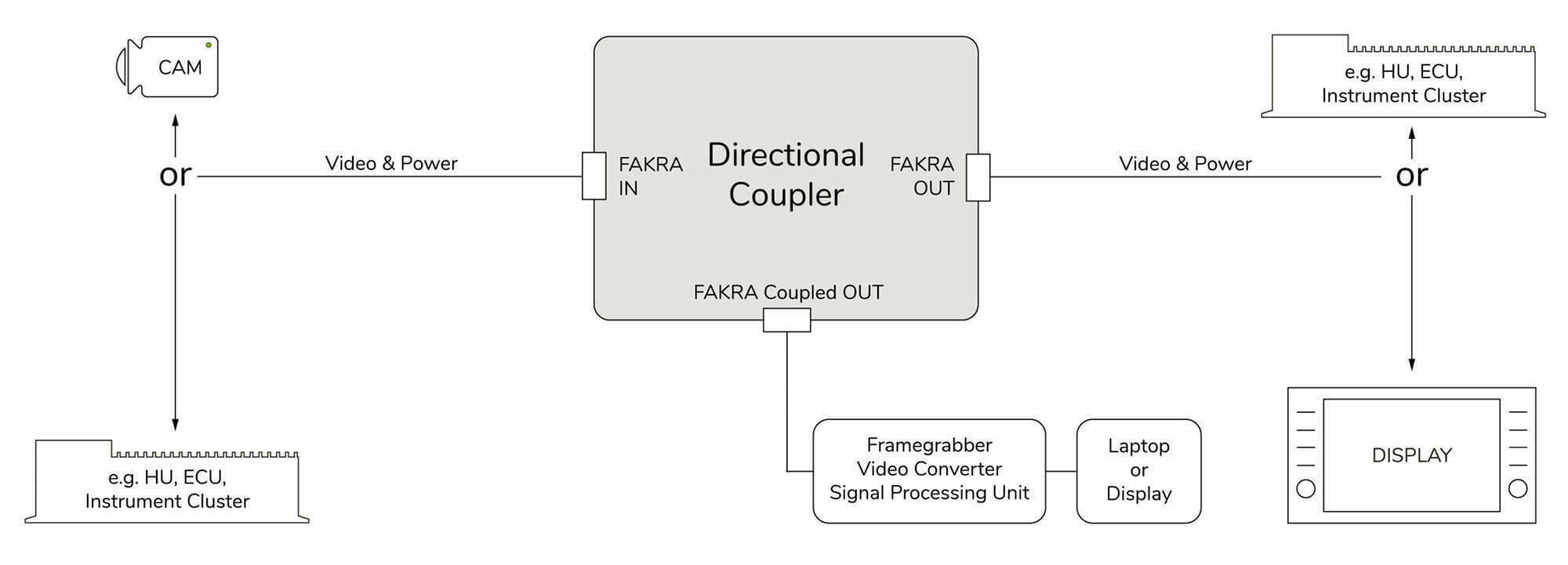
Our passive coupler was specially developed for signals between control units and displays. It can be used for all video connections that do not transmit power (PoC) via the video connection.
The intended application is to branch off video signals from a vehicle control unit in order to forward the video signal to an additional recording system. The intended application is shown in the following figure.
Use case 2
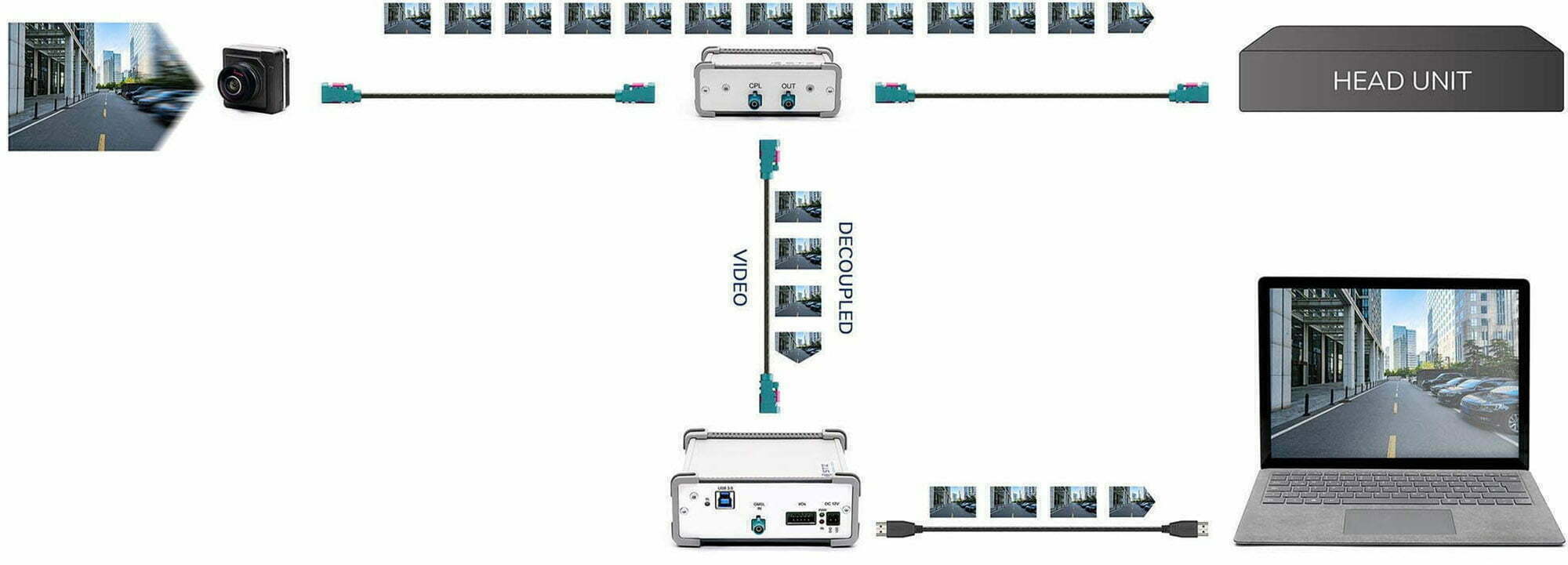
The PoC-capable couplers are specially designed for signals with Power over Coax. They ensure that the DC voltage for supplying cameras, for example, is routed through the coupler. At the same time, the signal (without DC voltage component) can be tapped at the forward output.
The intended use case is the tapping of video signals from a vehicle camera in order to forward the video signal to an additional recording system. The intended use case is shown in the following illustration.
Use case 3
The coupler can also be used for real-time monitoring of automotive video connections with an oscilloscope. This enables further analysis of the automotive video connections.
Coupling Mode
The coupler can be inserted at any point in a connection between a serializer (SER) and a deserializer (DES1). This has no effect on the connection between SER and DES1. An additional deserializer (DES2) can now be connected to the forward output of the coupler. DES2 cannot communicate with the serializer. DES2 must therefore be specially configured for compatibility with the SER.
In our TZ devices, we refer to this special configuration as “coupler mode”.
TZ offers the option to provide any setting for its deserializer products as a coupler mode setting. Such a setting then automatically ensures that a signal decoupled from the coupler can be processed.
If a non-TZ device is connected to the forward output of the coupler, special adjustments must be made to this device. Where possible, we offer support with precise instructions on what to do.
Difference between a coupler and a splitter
Our couplers are similar to splitters in some ways, but there are differences:
A coupler is used to split a signal losslessly and transparently without affecting the original signal transmission. The main signal remains completely intact – ideal for test and development environments.
A splitter actively or passively splits a signal into several outputs so that several devices can receive the same signal. With bidirectional signals in particular, the implementation of splitters is often only possible with restrictions.
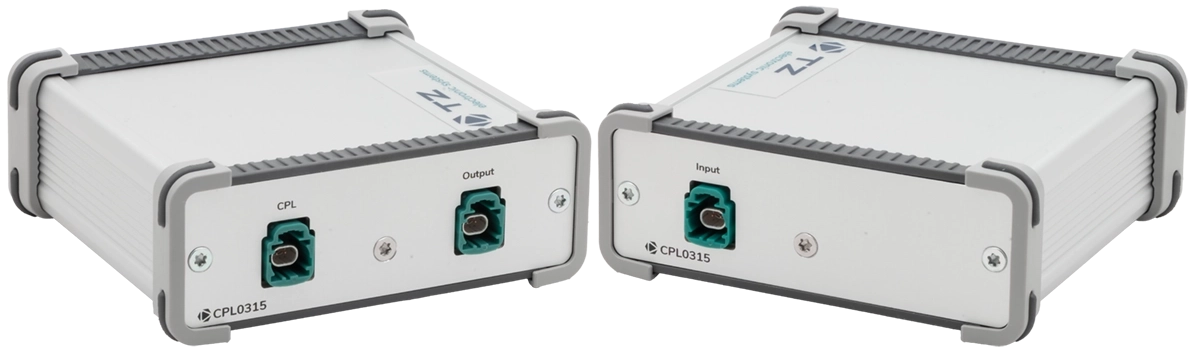
Product Overview
Scope of Supply
Thanks to our TZ-Settings© concept, our test devices are delivered ready for use, including all components required for operation, such as power supply unit, cable, plug, etc.