
POWER INJECTOR

Variable Power Supply for Automotive Cameras

Reliably Power, Test, and Validate Cameras with GMSL and FPD-Link Connections

TZ Power Injectors enable the targeted injection of an external supply voltage into automotive video connections. This allows vehicle cameras to be reliably operated, measured, and validated outside the vehicle, independent of the ECU’s original power supply, or in automated test systems.

An external laboratory power supply can be conveniently connected via standardized 4-mm banana jacks. Within the permissible voltage range of the respective Power Injector, the supply voltage and current consumption can be precisely adjusted, monitored, and documented.

TZ offers Power Injectors as standard products for GMSL- and FPD-Link-based automotive camera connections, as well as custom variants for other link technologies and specific testing requirements.

What is a Power Injector?

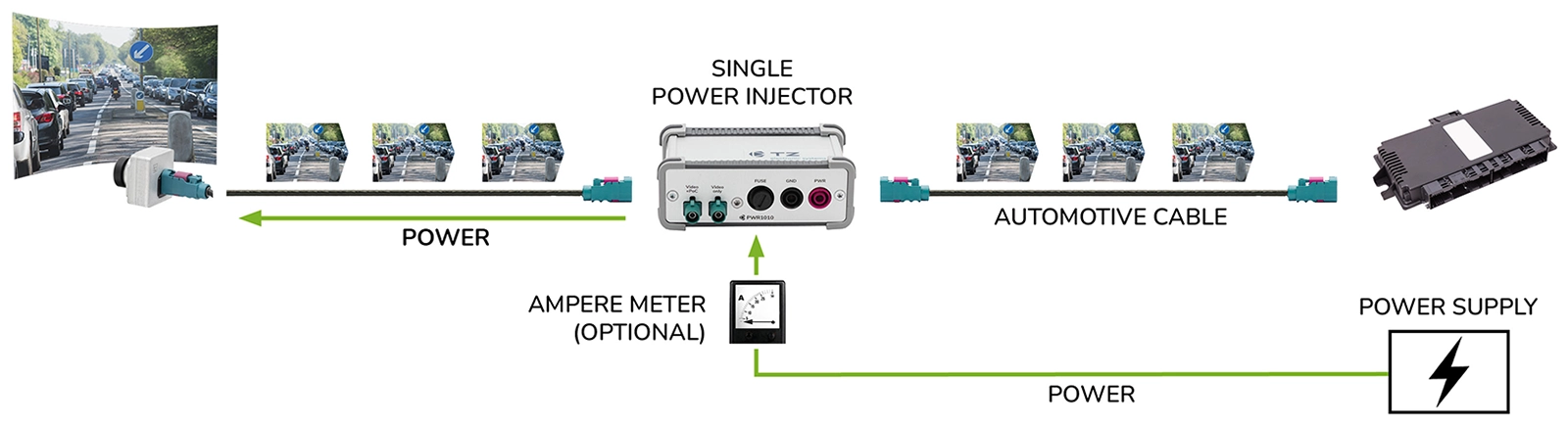
A power injector, also known as a PoC injector or Power-over-Coax injector, feeds an external supply voltage into an existing automotive video connection. The same connection can be used to simultaneously transmit the power supply as well as video, control, and communication data between the camera and the ECU, deserializer, frame grabber, or test system.

TZ Power Injectors are used to flexibly commission, test, and validate automotive cameras. They are suitable both for test systems without their own camera power supply and for applications in which the supply voltage provided by an ECU needs to be specifically replaced with a defined external voltage.

The answer to your challenges: variable power supply for vehicle cameras.
Power Injector

Variable power supply via a laboratory power supply unit

A key feature of the TZ Power Injectors is their freely adjustable external supply voltage. A laboratory power supply can be connected directly to the Power Injector via standardized 4-mm banana jacks.

Within the voltage range specified for the respective product, it is possible to specifically verify whether a camera covers the required operating voltage range. This is particularly relevant for development and validation tests, in which the camera must be tested not only at its rated voltage but also at the permissible voltage limits.

Typical Exams

  • Operation at minimum and maximum supply voltages
  • Analysis of Current Consumption as a Function of Supply Voltage
  • Investigation of Power-On and Startup Behavior
  • Tests for Undervoltage and Overvoltage
  • Testing Behavior During Voltage Dips and Voltage Fluctuations
  • Integration of high-precision laboratory power supplies and measuring instruments
  • Recording of voltage, current consumption, and camera behavior

TZ DC Decoupling – the camera receives only the defined test voltage

TZ Power Injectors decouple the DC power supply between the ECU and the camera. Even if the connected ECU already provides a supply voltage via the Automotive Video Link, the camera receives only the voltage supplied through the TZ Power Injector.

The supply voltage coming from the ECU is blocked on the camera side. At the same time, video, control, and data communication between the camera and the ECU or the connected test system remains intact.

This allows the camera to be operated with a clearly defined external voltage without the ECU’s power supply affecting the test results.

Benefits

  • Only the specified external voltage is applied to the camera
  • Decoupling a PoC voltage already supplied by the ECU
  • Reproducible electrical test conditions
  • Targeted testing of the actual operating voltage range
  • Investigation of Camera Behavior Under Undervoltage and Overvoltage Conditions
  • Maintenance of video, control, and data communications

TZ Fuse – Channel-by-Channel Protection for the Camera Power Supply

Each channel has its own replaceable fuse. If the fault current is too high, the fuse disconnects the affected power channel and helps protect the connected components and the test setup from further damage.

Channel-by-channel protection increases operational reliability during the commissioning of new cameras and makes it easier to locate faults. After a trip, the fuse can be replaced without having to replace the entire Power Injector.

Benefits

  • A separate, replaceable fuse for each channel
  • Limiting the Consequences of Faults in the Event of an Overcurrent or Short Circuit
  • Separate Protection for Individual Supply Channels
  • Quick fuse replacement in the event of a malfunction
  • Improved Operational Safety in the Laboratory and on the Test Bench

Tested PoC filter designs for high-speed automotive links

TZ uses PoC filter designs that have been tested by the respective link manufacturer for the corresponding link technology. The filters allow the supply voltage to be fed in while simultaneously transmitting high-frequency video, control, and communication signals.
The impedance-matched signal path and controlled manufacturing process of the TZ Power Injectors help minimize insertion loss and reflections in the transmission path.

Applications for TZ Power Injectors

Power Injector - Camera Setup

Camera Setup

Operation of automotive cameras in the lab or at a development workstation.

Power Injector - Voltage Range Test

Voltage Range Test.

Verifying whether a camera covers the required supply voltage range

Power Injector - ADAS Camera Tests

ADAS Camera Tests

Powering front, rear, surround-view, or interior cameras in test systems.

Power Injector - HIL and Automated Testing

HIL and Automated Testing

Integration into hardware-in-the-loop test benches and automated validation systems.

Power Injector - End-of-Line Testing

End-of-Line Inspection

Power Injector - Error Analysis

Error Analysis

Investigation of current draw, voltage drops, startup behavior, and boundary conditions.

Technology and Connector Compatibility

MODELL
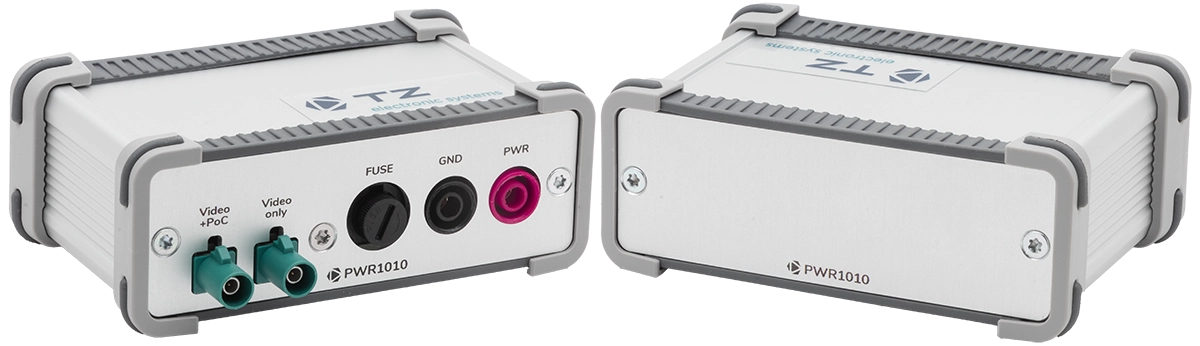
PWR1010
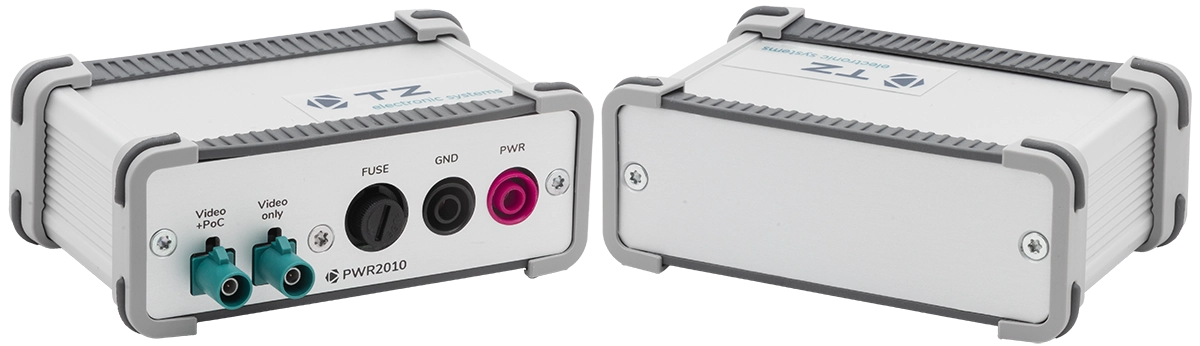
PWR2010
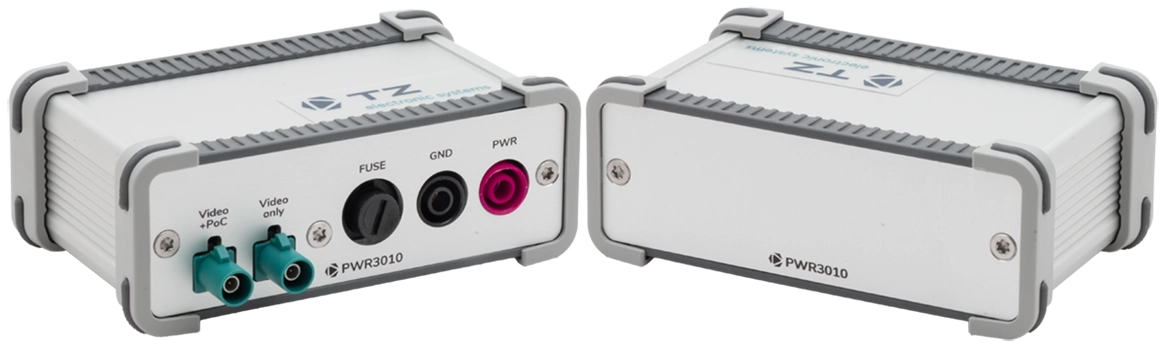
PWR3010
PWR4010
Typischer
Einsatz
Standard Power Injector
High Power Power Injector
Technologie
GMSL1
GMSL2
FPD-Link III
GMSL2, GMSL3
Steckverbinder
FAKRA
FAKRA
FAKRA
FAKRA
Anzahl
Kanäle
1
1
1
1
max. Ausgangsstrom
pro Kanal
630 mA
500 mA
630 mA
1,2 A
Bild vom Produkt

From the Power Injector to a Complete Camera Testing Solution

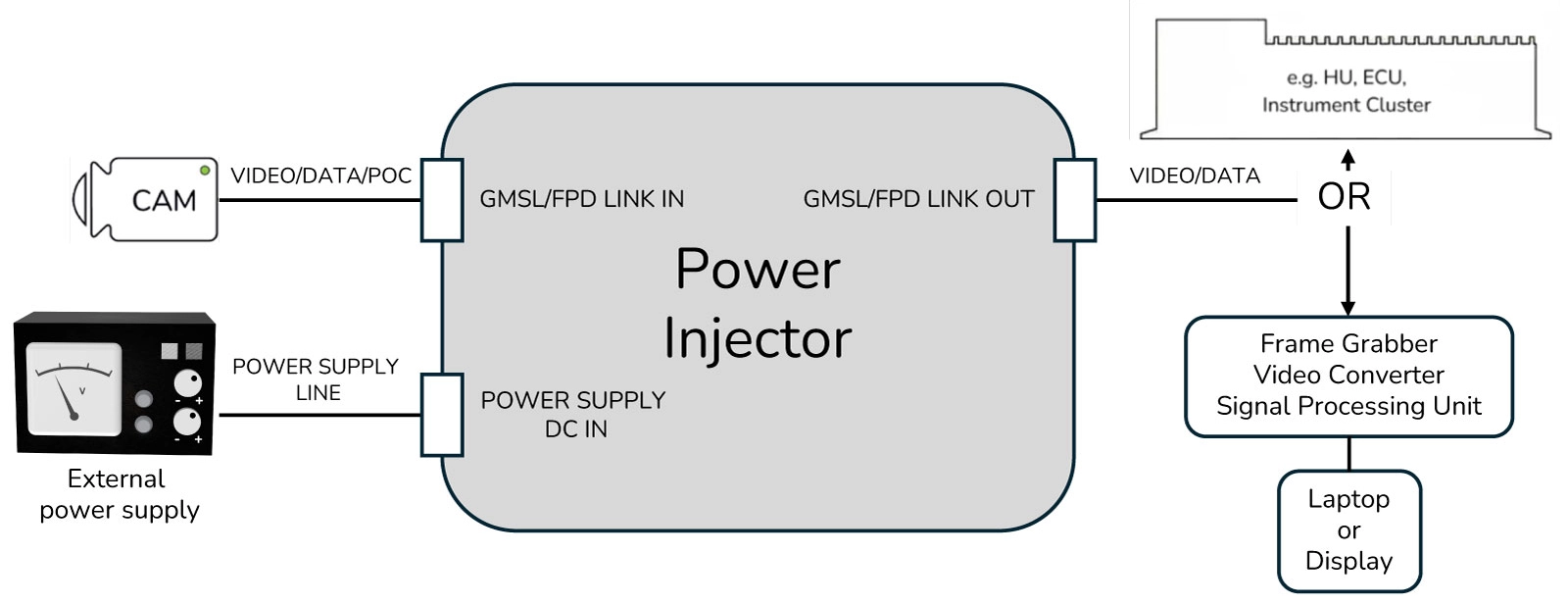
TZ Power Injectors can be combined with TZ Frame Grabbers and TZ Signal Processing Units. This creates a complete test setup for automotive cameras:

1. An external laboratory power supply provides the specified supply voltage.
2. The TZ Power Injector feeds this voltage into the Automotive Video Link.
3. The camera is powered via the link and transmits the camera signal.
4. A TZ Frame Grabber or a TZ SPU records the video signal and makes it available for visualization, analysis, or further processing.

Custom Power Injectors

In addition to standard products, TZ also develops custom Power Injectors for specific technical requirements. This is useful when the number of channels, connectors, PoC filters, current measurement, switching functions, or mechanical design are not covered by a standard product.

Custom solutions can be developed, for example, for validation test benches, HIL systems, production test stations, or laboratory setups with multiple camera channels.

  • Customized Number of Channels and Channel Architecture
  • Specific Connector Variants
  • PoC filter designs verified by the link manufacturer
  • Switchable PoC power supply per channel or channel group
  • Integrated fuses to protect the connected components
  • Measurement terminals or shunt resistors for current consumption analysis
  • USB or other interfaces for control and automation
  • Mechanical designs for laboratories, racks, or test stands
PWR0050 - Custom 24-Channel PoC Injector for GMSL1

PWR0050: Custom 24-channel PoC injector for GMSL1 with a separate current measurement shunt per channel and USB control

PWR0070 - Custom 24-Channel Power Injector for FPD-Link IV

PWR0070: Custom 24-channel power injector for FPD-Link IV with a separate current-sensing shunt per channel and USB control.

TZ electronic systems offers a carefully curated selection of power injectors. If your specific combination of requirements isn’t listed, we’ll be happy to customize a solution based on your individual needs. Request a specific quote from our product catalog or contact our technical customer service team to receive a no-obligation consultation on our comprehensive test solutions.

Power Injector variants

FAQ

What is a PoC injector?

A PoC injector supplies a power voltage to an automotive video connection, through which video, data, and control information are transmitted simultaneously.

Why do I need a Power Injector for automotive cameras?

A Power Injector is required if a camera is to be operated outside the vehicle or outside its original ECU environment, and the test system does not provide its own power supply for the camera or provides the wrong one.

Can I choose the supply voltage freely?

Yes. With TZ Power Injectors, the supply voltage can be provided by an external laboratory power supply. This allows for targeted analysis of voltage ranges, undervoltage, overvoltage, and startup behavior.

Can I measure the camera's power consumption?

Yes. External power supply via a laboratory power supply and measuring instruments enables the analysis of current consumption. For custom systems such as the PWR0050, measurement connections for shunt-based measurements are also available.

What link technologies are supported?

TZ offers power injectors for GMSL and FPD-Link technologies from stock. For other link technologies or special technical requirements, TZ develops custom power injectors upon request.

Can the Power Injector be used with TZ Frame Grabbers?

Yes. TZ Power Injectors can be combined with TZ Frame Grabbers and TZ Signal Processing Units to record and analyze camera signals.

Are custom variants available?

Yes. TZ can develop custom Power Injectors if the number of channels, connectors, switching functions, measurement functions, PoC filters, or design need to be customized.

What happens if the ECU is already outputting a PoC voltage?

The integrated DC decoupling prevents the supply voltage provided by the ECU from reaching the camera. The camera receives only the external voltage supplied via the TZ Power Injector. Video, control, and data communication remain unaffected.

Does the Power Injector affect video and data transmission?

TZ uses PoC filter designs that have been tested by the respective link manufacturer, as well as impedance-matched signal routing. This allows the supply voltage to be fed into the link while maintaining video and data communication.

How do I choose the right TZ Power Injector?

Key factors include the link technology used, the link generation, the connector, the required supply voltage, and the camera’s maximum continuous and peak current. For non-standard requirements, TZ develops custom power injectors.

Can an ECU continue to communicate with the camera despite DC decoupling?

Yes. DC decoupling isolates the power supply, while video, control, and communication data continue to be transmitted between the camera and the ECU or the connected test system.

Please contact us – our sales team will be happy to support you with your project